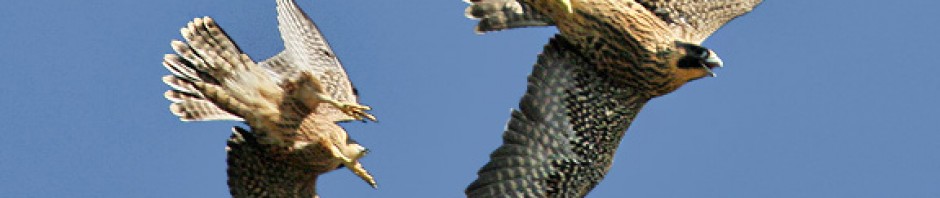
News flash! Gordon Robb, ardent falcon observer, called late this afternoon to tell me he saw a falcon chick in the north side “bowling ball” nest site.
“I’ll be right there!”
Six minutes later I arrive and now two chicks are visible. In twenty minutes, we have four scopes, two cameras, five sets of binoculars! Tomorrow will see a lot more optics.
I was not too far off on my timing of the birds hatching. Yesterday, May 1st, I observed the male falcon or tiercel bring in fresh prey and stash it in a larder, one of a few small holes they store food in. Neither of the falcons came to retrieve it in the two hours before I left the Rock.
Photo by Cleve Nash
This morning I saw the female bring into the nest site a plump, juicy morsel. So the chicks must have hatched last night or this morning. In about ten days to two weeks the young will come to the edge of the nest site to defecate over the side. This is something to see. The young fearless standing on the edge inches from a 300 foot fall. The young normally fly in forty four days on a normal year which will be about June 13-14.
For the past week, the behavior of the south side female falcon is consistent with egg laying, i.e. a couple of hours in the nest site, then comes out, flies around as usual and perches. Every thing you would do on a normal day.
Today, she was three plus hours in the eyrie and the tiercel brought in prey after an aerial food exchange in front of the nest site. She lands at the nest site. However, she does not leave and go to a “dining rock” with prey which would be normal procedure. Instead she takes a few quick bites at the edge of the nest site opening then returns to the back of the eyrie.
If she is incubating, normally she would leave with prey to eat and the male would take his turn on the eggs. But being a young pair, who knows! He might think she’ll do it all.
When I left at 3PM, she was still in the nest site. He was sitting on a rock 50 yards away.
If this is the beginning of incubation, and I think it is, chicks should hatch around the first of May. And be visible two to three weeks after that.
After months of watching and waiting with nothing to write about, today I was rewarded. I spent 90% of my time on the south side of Morro Rock logging in four to six hours a day trying to see if the new pair of falcons were going to breed and nest this year.
On a normal year the birds start breeding on the first of the year. The north side pair were a month late starting around February 2nd, 2021. The south side pair spent January and half of February on the ocean side of the Rock where they cannot be seen, but in the last two weeks they have been on the south side where they are readily visible. In that time the tiercel made attempts at breeding, but never landing on her.
Today was different. On the chimney within full view of eight people, two full copulations within four minutes, a total of three in fifteen minutes to a standing ovation.
Copulating peregrine falcons Photo by Cleve Nash
“Oh, to be young again.”
I turned eighty this past January. I remember when I didn’t give her time to take her socks off. Now she has time to knit a pair!
Happy trails, Bob
Item: I don’t mean to neglect the north side pair. They have been breeding continually since early February and I believe have chosen the “cathedral hole,” the site of last year’s nest site.
The peregrine falcons have been scarce on the “rock” for the last month or so. This is mainly due to all the migrating waterfowl coming into the back bay estuary during the fall and winter migration. I suppose now this is their holiday feast because we don’t see them returning to the “rock” with prey.
Just this morning two Bald Eagles were reported eating a coot on the pickle weed marsh. But this morning while watching surfers, I spotted what looked like a single falcon high on the skyline near where the waves break on the “rock.”
Photo by Bob Isenberg
With a closer look with my 10×42 binoculars, there were two falcons perched close to each other. This is the time of year they start renewing their bonds. Breeding can begin in the next month or two. The earliest I have seen copulation was 30 November ten or twelve years ago. For this pair of falcons, the first breeding of this year was 7 January 2020. This coming year at Morro Rock we should have two breeding pairs now that the south side tiercel has molted into adult plumage.
Photo by Heather O’Connor
Happy trails, Bob
Item: The two photos of the “rock,” one taken with an iPhone and the other with my Nikon P1000. The falcons are at a distance of 302 yards from me.
Yesterday, we took a drive to the Predatory Bird Research Group located in Santa Cruz, California, about a three hour drive to meet with Zeka Glucs, Ph.D., the Director, at her home to deliver the young falcon remains for further examination which would include DNA samples and mercury analysis. These are accomplished by removing three small scapular feathers from the back area for DNA.
She sexed the young falcon as a male by measuring the outside diameter (OD) of the tarsus (lower leg) and the beak from cere to tip. Males will be smaller in both measurements by mere millimeters.
“The Ken Norris Museum was very happy to add it to their collection. They love our specimens because they always come with so much associated data! For mercury we use the tip of the 4th secondary feather. It was grown while in the nest so we can estimate the area where their food was captured during that time. Generally mercury is associated with the marine food web so it will be valuable to have your Morro Rock peregrines represented.” Zeka Glucs
Happy trails, Bob
Item: From a meeting 8-10 years ago, I had met Zeka as a fledgling biologist at Morro Rock and helped her find the falcons. It’s such a pleasure meeting passionately involved people on their return trips to Morro Rock and hear how they have pursued their studies.
We had determined the sex of all four birds as two males and two females. All have been flying exceptionally well. The young males have been showing a lot of speed and agility.
Today, we were alerted by a visitor to Morro Rock that a man had seen a dead juvenile peregrine on the beach on the south side of the Rock parking lot. Three of our crew went to see and verify the sighting. Among the rocks where the sand meets the bluff, it lay wedged between the rocks. A beautiful young falcon in perfect condition.
Any number of things could have happened. I won’t speculate, but I have read that 50% of young birds will not survive their first year. It’s sad, but we will still have three chicks to enjoy.
Happy trails, Bob
Item: When I examined the bird the right wing felt broken, the beak near the right side of the cere was scraped and bleeding and the right eye was injured.
For many of you that have been to Morro Rock and seen me on the south side for years know that I have befriended many of the small birds, mainly the White-crowned sparrows with offerings of Pecan Sandies. One bird in particular, a banded White-crowned Sparrow would sit on my finger enjoying one of the cookies. This bird is “Bandi.” For seven years, she would bring her chicks to me to feed them the Pecan Sandies. Over the years, many have come to sit on my knee or finger. For some reason people love to photograph this.
Photo by Teddy Llovett
For the last three years the gate has been closed to the south side and I have been watching the pair of falcons on the north side. Bandi had made the trip to visit and always seems to find me. Yesterday, she made the 500 yard trip with one of her new babies. My folding chair has a table with a sunken cup that I fill with cookie crumbs and many of the birds know it’s there. Bandi and her chick were on the table. The chick won’t eat anything unless it’s from Bandi’s beak, even if the crumbs are at its feet.
Photo by Teddy Llovett
Happy trails, Bob
Item: All four falcons have successfully fledged. One female is an exceptional flyer and somewhat of a loner. I have determined the sex of three of the birds, but it is hard to get all four flying or perched at once so that I can see the size difference. For now we have two females and one male…more to come.
(Even though Bob doesn’t like to name birds, he calls the exceptional flyer, “Wonder Woman.” But don’t tell anybody! ~Heather)
I got a lot of questions from my last posting, “Cuatro Falco.” I’d like to thank all of you for your interest.
Question: When do you think they’ll fledge?
Answer: My original thoughts are based on my observations. These dates may be off on various incubation and hatching days. Based on my estimated incubation date, when the male starts sitting on the eggs which could happen at day or night possibly when I’m not there. With that in mind, fledging would be around June 1, 2020. My guess now is that they are now 32 days old today. They normally fledge at 44 days old. So add 12 days and that would bring us to May 25.
Question: Any thoughts that might favor a four chick brood?
Answer: None, all conditions seem to be normal.
Question: Do you think they will all make it?
Answer: Yes, they all look very healthy at 32 days old. Young are usually lost in the first week of life.
From May 4th when the first chick was observed on the north side of Morro Rock until this morning at 11AM, we have been watching three healthy peregrine chicks. At 11:10 AM a fourth one appeared making his debut with a splash of fecal material on the side wall of the cave. I had been watching the other three through the scope standing out on the lip of the nest site when I saw movement between them and splash! He or she made a couple more appearances in the following hour. Only three of us were able to see this fourth bird. He/she’s very elusive, never coming more than half way to the edge of the eyrie.
Gordon was happy and said, “I told you so!”
This is the third clutch of four chicks that I have seen in thirty years at Morro Rock!
Happy trails, Bob
Item: Many of my friends got the word by noon and came to the Rock to see the fourth chick, but he/she never made another appearance.
South side of Morro Rock-During breeding season through fledging: Late December-July. (Sometimes the CA State Parks closes the gate and makes it impossible to take Bob's truck out to set up during the winter. Call first.)
If you wish to find Bob Isenberg check the north side of Morro Rock, where he photographs surfers many mornings.
Privacy & Cookies: This site uses cookies. By continuing to use this website, you agree to their use.
To find out more, including how to control cookies, see here:
Cookie Policy