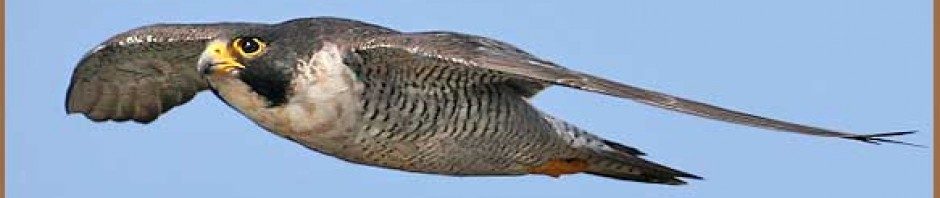
We’ve had a new female for the last month. Don’t know what happened to Sierra, the resident female of fourteen years. She was the only banded bird we have had at the Rock in the forty plus years that I have been watching. She fledged twenty four chicks and I miss her.
It’s hard to tell if the male is the same one that Sierra had or a new one. He looks similar in feather color and pattern, but acts differently by landing on new and different perches making it difficult locate him at various times.
Today I found them perched one foot apart. These are signs of early bonding. Time will tell, but it looks promising. The perch below is what we call the “butcher block” where they normally eat.
iPhone photo of the bonding pair of Peregrine falcons by Gordon Robb
Yesterday, the summer solstice, the last young one flew. She or he was a week or more younger than the first one that flew the Monday before.* Not quite as adept as the first bird, but give him or her a couple of days.
Today both young were perched on the same rock for two hours. Good viewing the first half hour then the one facing us turned around and went to sleep. All you could see were two tails. They looked like lawn darts. A great day. We had all four birds in view all day.
Happy trails, Bob and Jerry
* It’s possible the females on the first egg before all the eggs were laid. The normal procedure is to sit on the eggs when all the eggs are laid. All would hatch at the same time. That would be the normal order of events.
A second chick, eyas*, showed its face the other day and photographers are showing theirs.
One eyas Photo by Alice Cahill
Alice Cahill, one of the most dedicated birders has been there early every morning and has gotten some great shots of the two young falcons. Some of her work is shown here.
Two eyases Photo by Alice Cahill
The young are thirty days old today and should fledge around the summer solstice, June 20-22. Don’t miss it!
Breakfast time for one chick or eyas Photo by Alice Cahill
As you see in the photo above, the prey will continually be delivered. The chicks will be demanding more and more food as they grow. It’ll be a full time job for the parents.
Happy trails, Bob and Jerry
Item: Please don’t take my dates and timing as gospel.
*An eyas (plural: eyases) is a very young, unfledged hawk or falcon – often still in its nest that is typically too young to fly.
It seems like it’s been forever with these young ones. I am only a month off on my predictions, but today, Election Day at 12:03PM we got our first look at a little white fuzz ball. He or she looks to be 22-23 days old. The young one only stayed out for a couple of minutes just to the right of the “Diving Board.” Heather and I left the Rock at 2 PM and the chick had not been seen again.
Diving Board hole Photo by Heather O’Connor
If you come to the Rock to see them on the south side it will be hit or miss for the first week or so. I’ll be there 10AM to 2 or 3PM or there about.
Happy trails Bob, Jerry and Heather (and the rest of the gang)
Look at the bottom row for Days 21 to 24
Photos taken in Eichsfeld-Hainich-Werratal Nature Park, Thuringia, Germany.
Expectant observers are patiently waiting to see something white and fuzzy appear at the nest site on the south side of Morro Rock. If my calculations are close, the young, we don’t know how many, should be approximately four or five days old today. Nest duties are going smoothly, exchanges about every two to three hours daily.
In previous years, the young normally appear between ten and fourteen days old. Now this is not gospel, so I could be a week off or more. We are right on top of it and we will post when the young do appear. So by the middle of the month, you should be guaranteed to see something. For the next four or five weeks, it’s the best time of the year in my opinion.
They are cute and fuzzy when they come to the edge of the diving board hole. See you then.
In another week or so, we should start seeing prey going into the eyrie. The parents never eat in the nest site. We should expect to see this around the 28th to the 30th of April. It is so hard to predict… the time of incubation, hatching of eggs , when food goes into the nest for the young and showing of the chicks. I’ve only been close twice in thirty years. As of late, I’ve only been watching the south side pair.
Occasionally I stop off and watch the north side pair. I can imagine the north side are about on the same schedule. All we can do is to keep watching the birds when they bring in prey to see where they take it. In the nest or they may perch outside and eat it themselves.
About the young, even though they may hatch around the end of the month, we won’t see them until a couple weeks later. Approximately, May 15th.
If you are around Morro Rock, come out and look though our high quality spotting scopes. It’s free to look and enjoy these magnificent birds. We will catch you up on the latest details when you arrive.
Happy trails, Bob and Jerry
Item: My guess is three chicks, Jerry chooses three chicks also. Heather is being ornery and choosing 2 chicks.
Our latest CalPoly Scholarship student is Allison Webenbauer who graduated in December of 2025 with a degree in Biological Sciences and a concentration in Ecology, Evolution, Biodiversity and Conservation. She was “a part of Dr.Francis’s Sensory Ecology and Evolution lab on campus, which kickstarted her involvement in various projects focused on avian conservation research. The first project she was involved in was the Black Oystercatcher Monitoring project, where she spent two seasons monitoring Black Oystercatcher nesting sites across the central coast. She also conducted a research project over the summer of 2025 through Cal Poly’s Frost summer research program, investigating acoustic lure detection by Barn Owls in local vineyards. Through this project she aimed to better understand methods to optimize the use of natural predators for rodent control in agroecological systems.”
In addition, she is “working on the Snowy Plover and Least Tern monitoring team at the Oceano Dunes State Vehicular Recreation Area. In the future she aims to continue working in conservation research and outreach to protect avian communities in our constantly changing environment.”
We enticed her to come out to visit Bob Isenberg during the Morro Bay Winter Bird Festival in January 2026. She is currently training and working at Camp Keep in Montaña de Oro south of Los Osos.
Camp Keep is a residential outdoor science program located on the Central Coast of California. “For over 50 years, students have developed personal responsibility and gained respect for others by participating in this shared living experience.”
Bob has always gained pleasure from meeting the students receiving scholarship. He’s out at Morro Rock everyday checking on the peregrines and collecting donations daily. We just sent off another $1,000 check to CalPoly for another student this year and will let you know when we hear who it will be.
Our sixth CalPoly Scholarship student that we did not meet was Walter P. Kessler. He received a $1,000 Calpoly Scholarship in 2023. If you know him, please contact us.
Photo by Cleve NashPhoto by Gary O’NeillPhoto by Gary O’Neill
These are my favorite days with the falcons. High speed antics, 20 G turns, chasing everything that flies… red-tails, turkey vultures, ospreys and anything else that gets in his way. Then the male leads the female to all previous nest sites trying to let her know “where to go.”
I am now looking at the female perched on an outcropping of rocks watching him, watching every move he makes. She does not go into her submissive pose, a signal for copulation. It’s too early. He’ll have to do more flying, more acrobatics. She didn’t seem to be much impressed with his first band of courtship flights, but it should continue for a couple more days. Tomorrow will be another day and we hope to see more flying.
Today the visitors that watched were visibly impressed with the speed and agility of the sixteen year old tiercel (male). Copulation should begin the first week or two in January. More to come.
Happy trails, Bob and Jerry
P.S. One visitor said she could not turn her head fast enough to follow him across the face of the Rock.
It’s a very exciting time right now as we have two healthy fledglings on the south side of Morro Rock. I arrived at 10:00 AM today glassing the area for our new arrivals. Then I heard that unmistakable call off to my right. Quickly setting up my scope I soon found one of juveniles on a rocky slope about 50 yards away. Scanning the surrounding area, I saw the second fledgling about 20 feet to the left.
After about 30 minutes, the adult female came flying in with prey, and the chase was on! The youngsters put on a great show trying to catch up to the female attempting to take the bird from her. In all the ruckus, she dropped the prey into a rocky ravine and had to retrieve it. Finally getting settled down, she plucked the bird and patiently fed both chicks until they were satisfied. The fledglings stayed at that site for the next two hours until they both took flight.
Adult with two juveniles. Photo by Dean Thompson
We welcome you to come down to Morro Rock to share this experience with us. We are at the rock between 10:00AM and 2:00PM (approximately) and will gladly share our scopes with you.
That’s about it for now. Until next time……Jerry
P.S. Jerry happily wrote up his exciting observations while Bob was traveling in Oregon.
Since Bob is in Hermiston, Oregon visiting his daughter, Jerry has been observing the peregrines at Morro Rock with all the regular visitors. I, also, went out to see the juveniles today. Many visitors had noticed the birds fledging since the beginning of June on the 1st. They are flying well so they have had several days being barely noticed except by a few people.
Today Jerry captured a photo on his iPhone looking through the spotting scope below.
Two juveniles being fed by the female Peregrine Photo by Jerry Pyle
South side of Morro Rock-During breeding season through fledging: Late December-July. (Sometimes the CA State Parks closes the gate and makes it impossible to take Bob's truck out to set up during the winter. Call first.)
If you wish to find Bob Isenberg check the north side of Morro Rock, where he photographs surfers many mornings.
Privacy & Cookies: This site uses cookies. By continuing to use this website, you agree to their use.
To find out more, including how to control cookies, see here:
Cookie Policy