Arriving at Morro Rock this morning, the one single chick on the north side the Rock was already airborne. Flying low and slow, we thought it might just be another bird.We had not expected the chick to fly for another week. When he landed we found him in a long strip of green brush with gull nests above and below him.
The magnified chick can be found in the lower right corner. Photo by Jim Twentyman
The adult female kept flying over and diving on him trying to get him to fly. With no luck, she then brought a bird to eat, which he did. Tomorrow we will be further to the south end of the north face of Morro Rock where all the chicks from the past seem to gather . It’s called the nursery.
Bob Isenberg in the light blue jacket, Jerry Pyle in the dark blue jacket at Morro Rock, Morro Bay, California.
Here are just a few updates on the falcons we have been watching on the north side of Morro Rock. We have moved our location and set-up of spotting scopes and chairs over to the surfer side of the parking lot to better observe the nest site. It is called the “bowling ball” nest. There are three holes that look like a grip with two holes below and a thumb hole above. By our observations, the chicks hatched about three days ago, the 14th of April 2023. We believe this because that was the day we first saw food go into the nest site.
Today, the male brought in two birds both within two hours. These were both mid-air transfers, male to female. Nothing is visible at the nest site. However we should see young chicks in about two weeks or so. If our calculations are close, the chicks should fledge around the week of the 27th of May. It’s an exciting time to watch the young and it’s free!
Happy trails, Bob
Item: Most everyone at the Rock placed their bets on “four” chicks. I’ll be safe and say “three.”
Pacific Coast Peregrine Watch has experienced a temporary set back due to the absence of Bob Isenberg.
I have undergone back surgery and am recuperating doing lots of rehabilitation at Bayside Care Center in Morro Bay, CA. Not to fear the Peregrine Falcons are in good hands with my buddy, Jerry Pyle, who is providing the spotting scopes and information.
The birds are beginning to nest now. Both pairs north and south have begun selecting nest sites in the last two weeks. Normal progression for this time of year is egg laying in the middle of April. Hatching will be thirty one to thirty three days later. Forty four days to fledging from day of hatching. In other words by the first of June, you should see young falcons flying.
Look for Jerry and the spotting scopes. On windy days you might not see Jerry or may find him on the south side of Morro Rock.
The peregrines continue breeding daily, about every hour or so, but not always where we can observe them. Yesterday we did watch the pair breed twice on the skyline an hour and ten minutes apart. That first coupling occurred while the female was eating a small bird the male had brought her. As spring continues, copulations will become more frequent, by April coupling can occur every thirty minutes.
Item: The sex act called a “cloacal kiss” takes 5 to 10 seconds to complete.
Peregrine falcons breeding Photos by Cleve Nash
For those of you who have kindly used Amazon Smile to benefit our Pacific Coast Peregrine Watch, a 501(c) 3 not for profit, we thank you.
We have been notified that “TheAmazonSmile customer-directed donation program will permanently shut down on February 20, 2023. To learn more, visit here. Read more about Amazon’s ongoing community support here.”
If you wish to continue donating a little or large amount, we would be eternally grateful for you to mail a check or use the DONATE button.
For the last two months, all we have seen of the Peregrine Falcons in that time is a flyby once maybe twice a week, but no landings or something we could put a scope on. Instead, we have been watching the Burrowing Owl since October 9.
Burrowing Owl Photo by Heather O’Connor
He has kept us afloat all this time. But now the falcons are back and with a flurry! Chupping like crazy, bonding, hugging, beaking, feaking and making a fuss over each other. Everybody is happy!
Peregrine Falcon Photo by David Lawrence
During all this time the falcons have been mostly back in the Bay estuary feeding on all the wintering ducks* that have been arriving in late fall. It happens every year. I just get twitterpated when I have nothing to see or write about.
We had a very busy birding year with Bob going daily to Morro Rock showing hundreds of visitors the Peregrine Falcons, a Burrowing Owl and many other birds. Heather went out eBirding keeping Checklists for Cornell most days and is up to 277 species in the San Luis Obispo County so far. She also went on a Pelagic Trip.
Photos from Top Left down. Peregrine Falcon, Burrowing Owl, Bob, Pigeon Guillemot, Blue Grosbeak, Western Gull, Black-crowned Night Heron, Nuptials’s Woodpecker, Black Oystercatcher, Heather, Black-footed Albatross, American Avocet.
Our best to you in the New Year
Bob Isenberg and Heather O’Connor in Morro Bay, California, USA
One of our recipients of a Pacific Coast Peregrine Watch scholarship, Nicole Durtschi, is now a Biologist with the California State Parks and was willing to show me around the protected Least Tern nesting sites.
Photo by Heather O’Connor
We hopped into a CA State Park 4×4 pick-up truck to visit the area that had experienced habitat loss due to the hot-rodding of dune buggies flattening out the rolling sand dunes. Out we went into wind and onto the trails to observe how the CA State Parks were protecting the Least Terns.
Photo by Heather O’Connor
Because public access with off-road vehicles had degraded the habitat, straw piles had been put out to help the wind build up the dunes during the pandemic. Native seeds and plants were scattered and planted over the area. Vegetation was now growing well. It produced a perfect habitat for Least Terns and Snowy Plovers to nest in.
Photo by Heather O’Connor
Terns will make several scrapes. The female will choose to occupy a scrape. It’s a little hollow in the sand, soil or light colored pebbles with a few bits of wood or grass stems added at times after incubation has begun.
*Photo by John Van de Graaff https://birdsoftheworld.org/bow/species/leater1/cur/breeding#nestsite
Usually two beige to light olive with darker speckled eggs are laid. Nicole told me of a method to tell when the tern eggs will hatch. They float an egg in water and according to the angle at which it floats, they will calculate the date when it should hatch.
*Photo by Arthur Morris https://birdsoftheworld.org/bow/species/leater1/cur/breeding#nestsite
Nicole had been working with the State Parks to protect Least Terns for four years and had seen a promising increase in numbers of nests. She had a map of locations and a data sheet to record more information about the terns’ nesting conditions as we drove slowly through the sandy trails.
Disturbances by human, avian and terrestrial predators have caused fewer chicks to survive. Yes, we did have to stop and remind people to not go beyond the signed closed off area. Several years ago a skunk was a major predator. Since then Northern Harriers and other raptors caused attrition. This year an American Kestrel is causing problems.
After visiting many locations to collect her data and to give me an opportunity to take a few photos, we headed back. It was very educational to learn more about a new bird for me and its life cycle in the nesting season. I’m so glad the effort is being made locally to protect one of the over 10,000 species of birds on this planet!
Happy trails, Heather and Bob
*Photos other than mine that I have used are credited to individual photographers who contribute to the Cornell Lab of Ornithology Birds of the World and Macaulay Library
Petra and Jack Clayton have contributed another peregrine falcon video for you to watch. They have been posting videos on www.flickr.com for years to show the activity of so many different species of birds. Maybe you’d like to follow them.
One of the reasons we show you what is going on at Morro Rock is to support our efforts to raise money to give to a CalPoly Wildlife Biology student a scholarship. This past week we sent off $1,000 to CalPoly for that very reason.
Now is the time to make the contribution you’d been planning to give. Please use the DONATE button on the right side or mail a check made out to Pacific Coast Peregrine Watch to 765 Center Ct., Morro Bay CA 93442.
This coming Tuesday, Heather will be going out to see the nesting Least Terns with one of our previous CalPoly Biology Scholarship recipients. It makes a significant difference in our lives to support the students in their science endeavors these days.
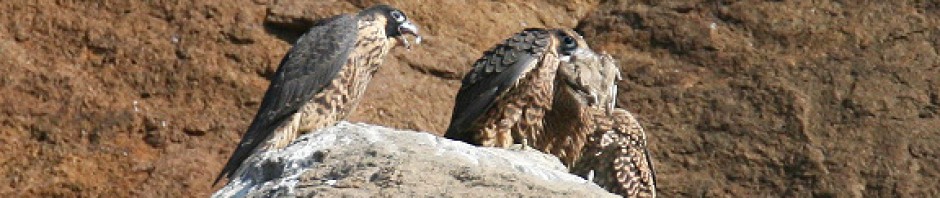
The young peregrines, two of them, on the South side fledged yesterday, May 31. I was not there to see this, but my cronies were there. Jack and Petra Clayton, Gordon Robb, Jerry Pyle.
Fledgling Photo by Jack and Petra Clayton
But today I was there at 7:30 AM. Not one bird, adult or chick, would show up for two hours. After glassing the Rock, which seemed like forever, I found a young chick in a jumble of rocks, so camouflaged in its coloring.
A landing Photo by Jack and Petra Clayton
I must have passed over it two or three times. All we saw in six and a half hours of observation were the two adults and the one chick. I hope nothing is amiss.
I mentioned in the last post that the north side peregrine chicks were flying well. Landings are a little shaky, but soon, they will have them down pat! These are the photos taken of the first attempts.
Photos by Steve Acheff
Thinking about flying is important.
Photos by Steve Acheff
Chicks are building muscle strength before the first flights.
Photos by Steve Acheff
Flying into the eyrie is a safe place to try the first flight, don’t you think? Or is it more wing strengthening?
Ever day I search for the new location where they might have flown to and landed.
South side of Morro Rock-During breeding season through fledging: Late December-July. (Sometimes the CA State Parks closes the gate and makes it impossible to take Bob's truck out to set up during the winter. Call first.)
If you wish to find Bob Isenberg check the north side of Morro Rock, where he photographs surfers many mornings.
Privacy & Cookies: This site uses cookies. By continuing to use this website, you agree to their use.
To find out more, including how to control cookies, see here:
Cookie Policy