



Follow Blog via Email
Join 1,617 other subscribersSupport the Peregrine Watch
-
Recent Posts
- First chick debut… June 2, 2026
- Patiently waiting… May 4, 2026
- Day 24 incubation… April 21, 2026
- Meet the 8th Scholarship student… March 18, 2026
- Courtship begins… December 27, 2025
June 2026 S M T W T F S 1 2 3 4 5 6 7 8 9 10 11 12 13 14 15 16 17 18 19 20 21 22 23 24 25 26 27 28 29 30 Archives
Details
Tags
- accident or injury
- artwork
- Bob Isenberg
- breeding
- brooding
- California
- California Polytechnic State University
- chicks
- Cleve Nash
- courtship
- Doris
- eagles
- education
- eggs
- falcon
- feeding
- gulls
- Heather O'Connor
- hunting
- incubation
- invaders
- juvenile
- mammals
- migration
- Morro Bay
- Morro Bay Winter Bird Festival
- Morro Rock
- other birds
- owl
- peregrines
- photography
- Piedras Blancas Lighthouse
- prey
- scholarship
- Shell Beach
- shorebird
- solstice
- stoop
- summer
- survival
- visitor
- vultures
- weather
- whales
- winter
Join us on Facebook
Blog Archives
Over the last few weeks…
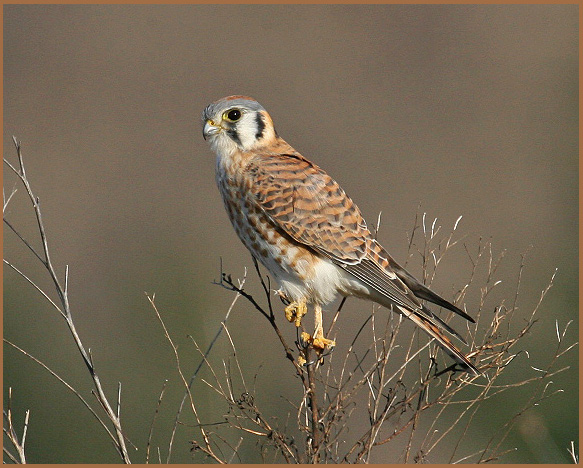
I’ve been away from the notebook and pen for some time tying up some loose ends. I’ll try to get you up to speed. Over the last few weeks things have been slow. The adults have chased off all of their young on both sides of “the rock.” Yesterday there were five Red-tailed Hawks circling the rock up high. Both pairs of falcons were busy chasing them with a lot of vocalizing and high speed stoops.
A young female Kestrel circled the rock from seaward passing right in front of the male and female resident falcons and they did not give chase. The Kestrel, previously known as a sparrow hawk, landed in a bare willow at the top of a rock sprawl and spent twenty minutes just looking around still in plain sight of the falcons and they still did not give chase. The Kestrel left by way of the sand spit, probably a juvenile looking for a home.
The first of the migrating birds of prey have started to arrive along the Central Coast of California. White-tailed Kites, Ferruginous Hawks, Merlins, Cooper’s and Sharp-shinned Hawks. A few flocks of ducks, but no geese yet in the estuary.
Heather has been supporting the eye surgeons from here to UCLA with her fourth lens replacement to come next week. We all wish her the best of luck.
Happy trails, Bob
Share this:
Posted in falcon, juvenile, Morro Rock
Tagged falcon, invaders, juvenile, Morro Rock, other birds
3 Comments
You don’t need a $10,000 lens…
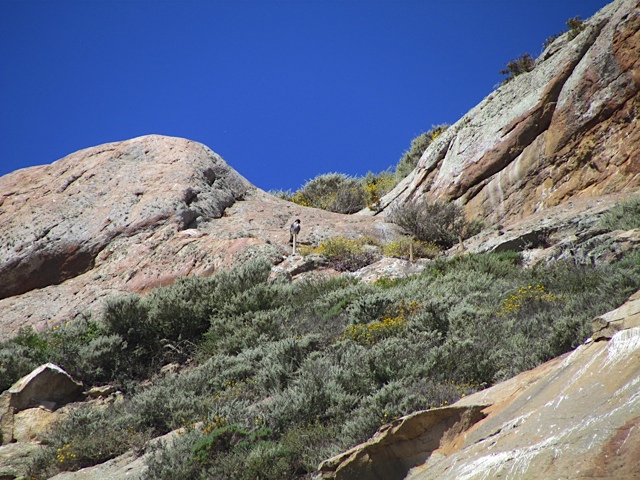
Earlier I answered a letter to a blogger and mentioned most photographers use 400, 500 and 600 mm lenses. I don’t mean to disappoint other photographers who cannot afford these very expensive lenses. The photograph above was taken with my Canon SX 35, a $375 “point and shoot” at 200 yards. In the center of this photo is a peregrine sitting on a post high up on Morro Rock. As you zoom in on this photo, you can see what $375 can do. Good luck with yours! ~Bob
Share this:
A healthy happy peregrine…
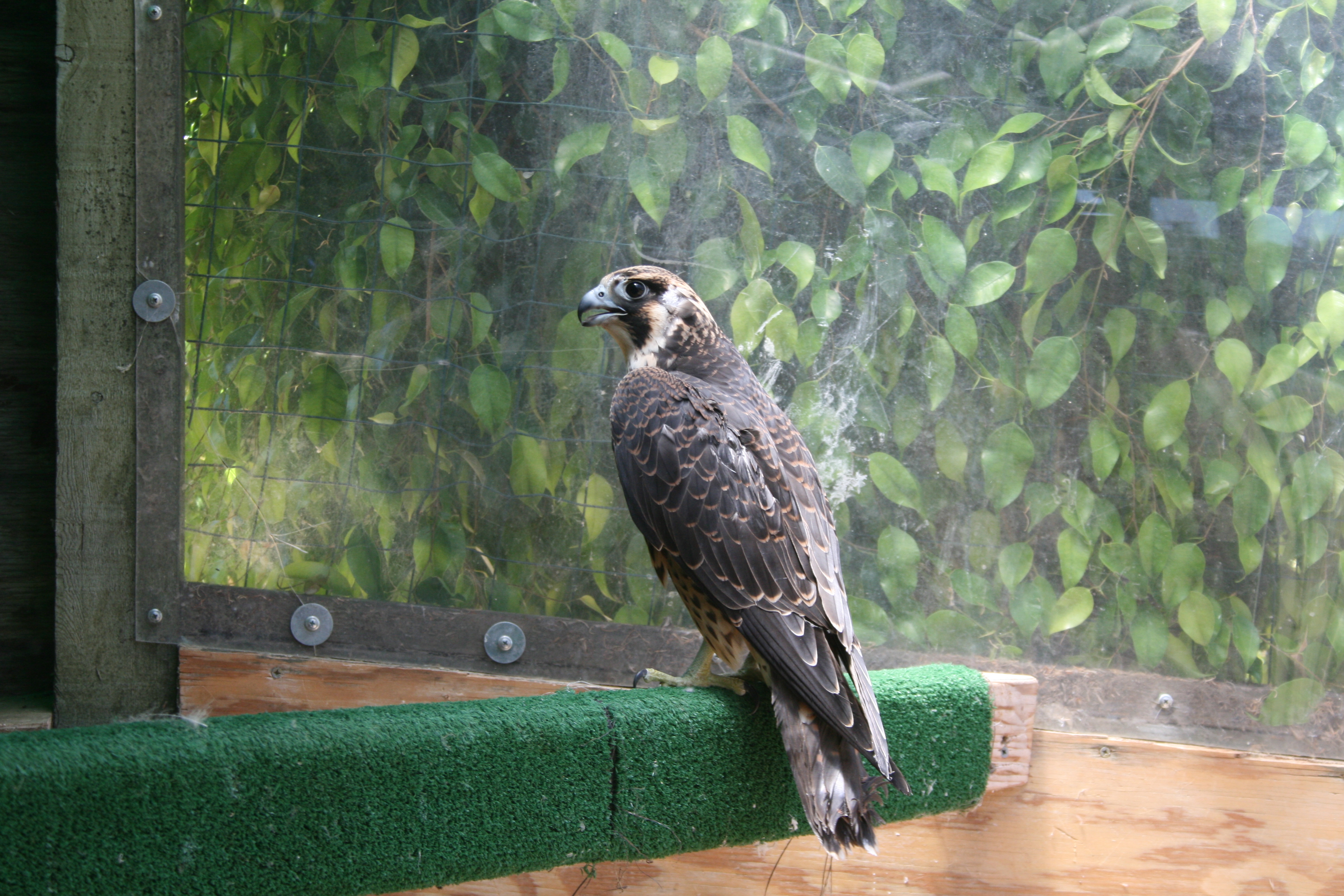
Photo by Jeri Roberts of the peregrine just before release..
Rehabilitation has done wonders for our peregrine juvenile who after release is now soaring over the sand-spit beyond Morro Bay hunting and surviving on her own. A true success story. ~Heather
Share this:
Posted in falcon, hunting, juvenile
Tagged accident or injury, falcon, feeding, hunting, juvenile, peregrines, survival
Leave a comment
Transfer to another place…
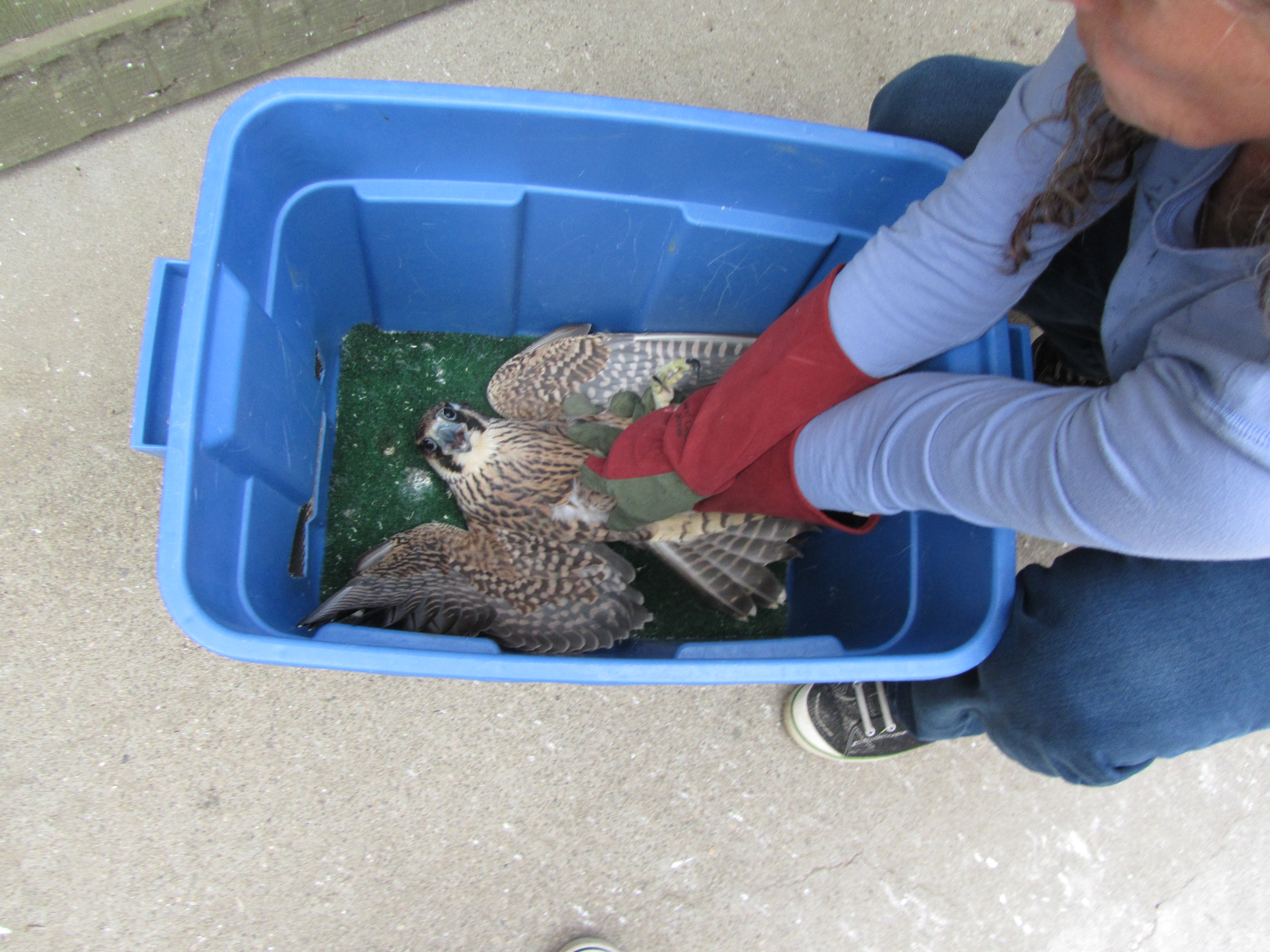
Photo by Jeri Roberts’ assistant
Here is a photo showing the gentle care by Jeri of the juvenile when it was to be moved to another location. Gloves are always used for protection. ~Heather
Share this:
Posted in falcon, juvenile
Tagged accident or injury, falcon, juvenile, peregrines, survival
Leave a comment
Previous days of recovery…
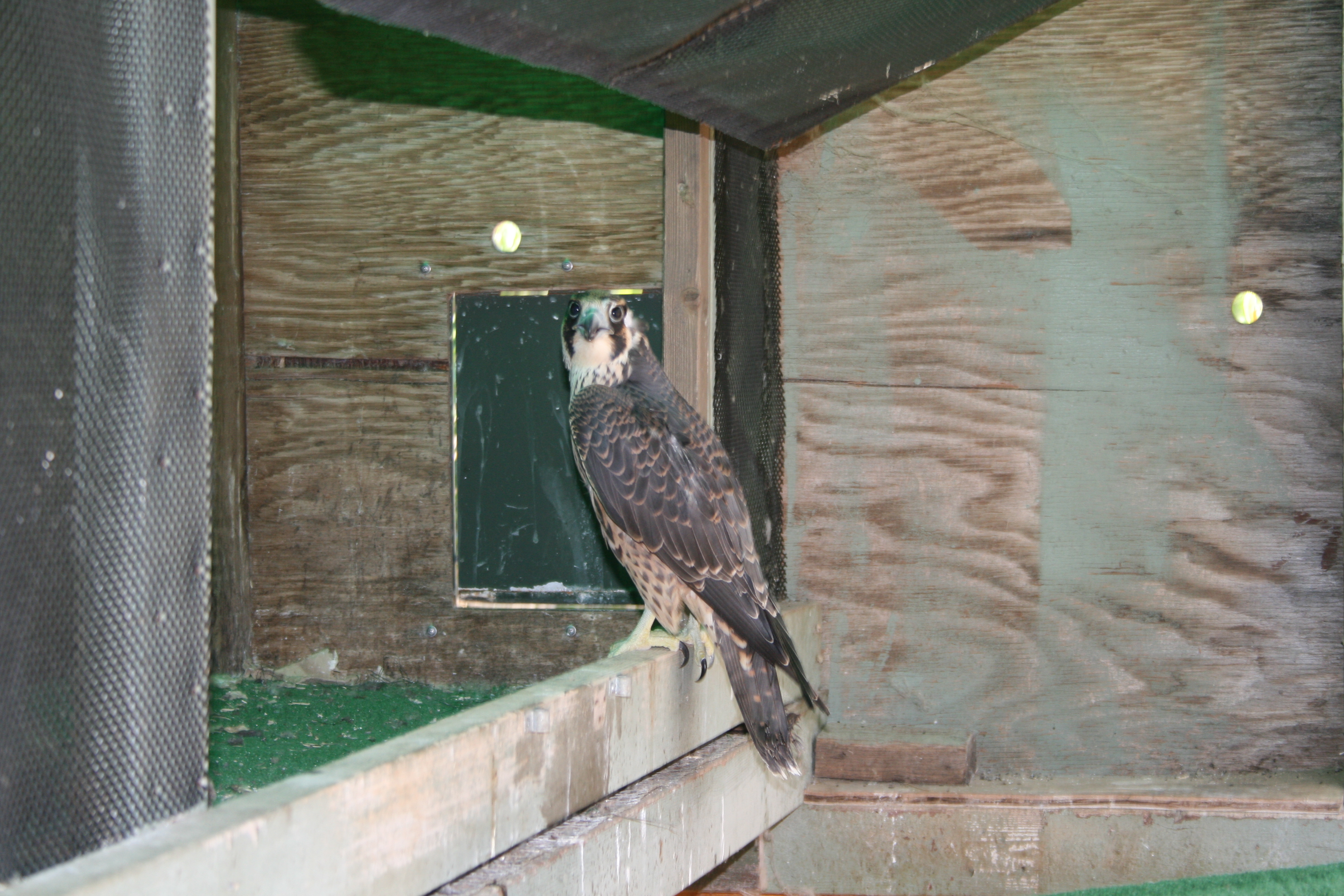
Photos by Jeri Roberts.
I’m adding a few photos to show how Jeri Roberts rehabilitated the peregrine juvenile. It has since been released. ~Heather
Here is another photo. The one where she is perched again shows the feed door (old dog door) where I can deliver food without being seen and she is going into smaller caged area within the larger flight cage that has shade cloth on it that can act like a “cave” that she seemed to like for eating and sleeping sometimes. ~Jeri
Share this:
Posted in falcon, juvenile
Tagged accident or injury, falcon, feeding, juvenile, peregrines, survival
Leave a comment
Peregrine on the wing…
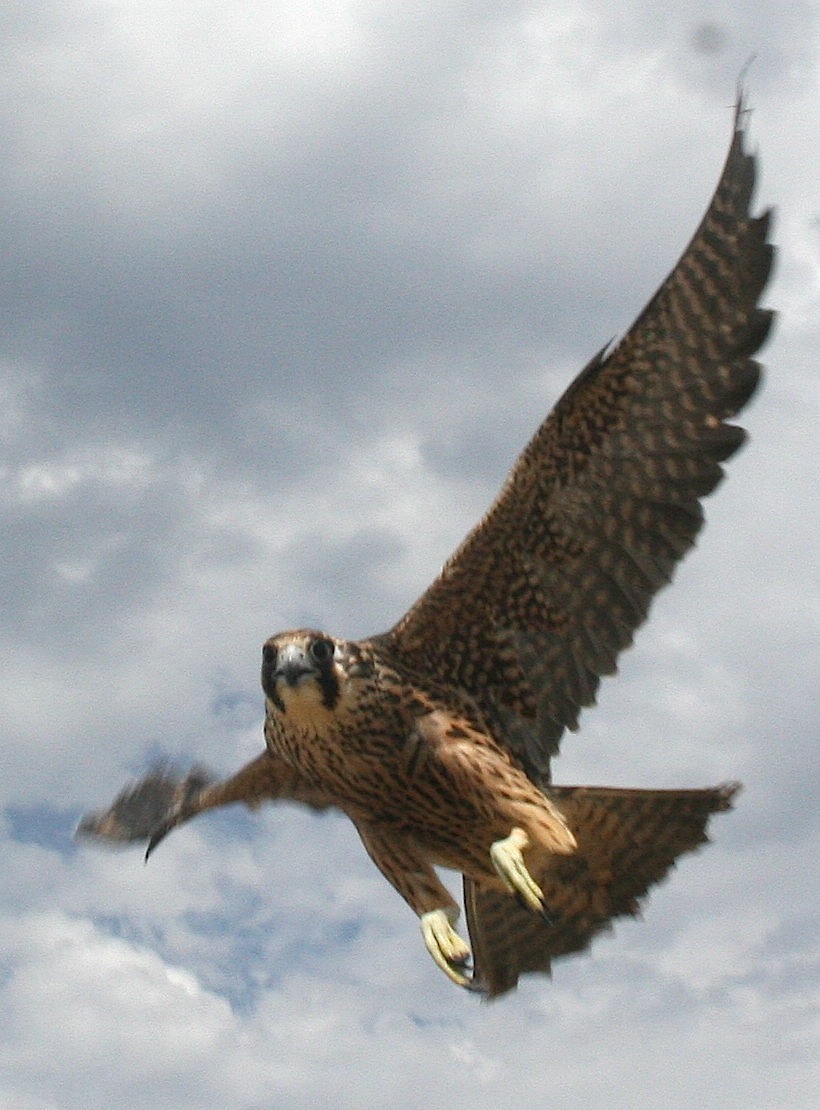
Article and photo by Neil Farrell, Tolosa Press
The article in the following post is what locals read when the Bay News was delivered about town. The people attending the release of the juvenile were Jeri Roberts, skilled rehabilitator of falcons, Brian Roberts, her husband, Bob Isenberg, of Pacific Coast Peregrine Watch, Joyce Cory, birdwatching blogger, Neill Farrell, writer, Jeremiah and Jason of the Harbor Patrrol and me. How fortunate we were to see this exciting event. ~Heather
Share this:
Posted in falcon, juvenile, Morro Rock
Tagged accident or injury, falcon, juvenile, Morro Rock, peregrines, survival
Leave a comment
Peregrine Saved and Released in Morro Bay…
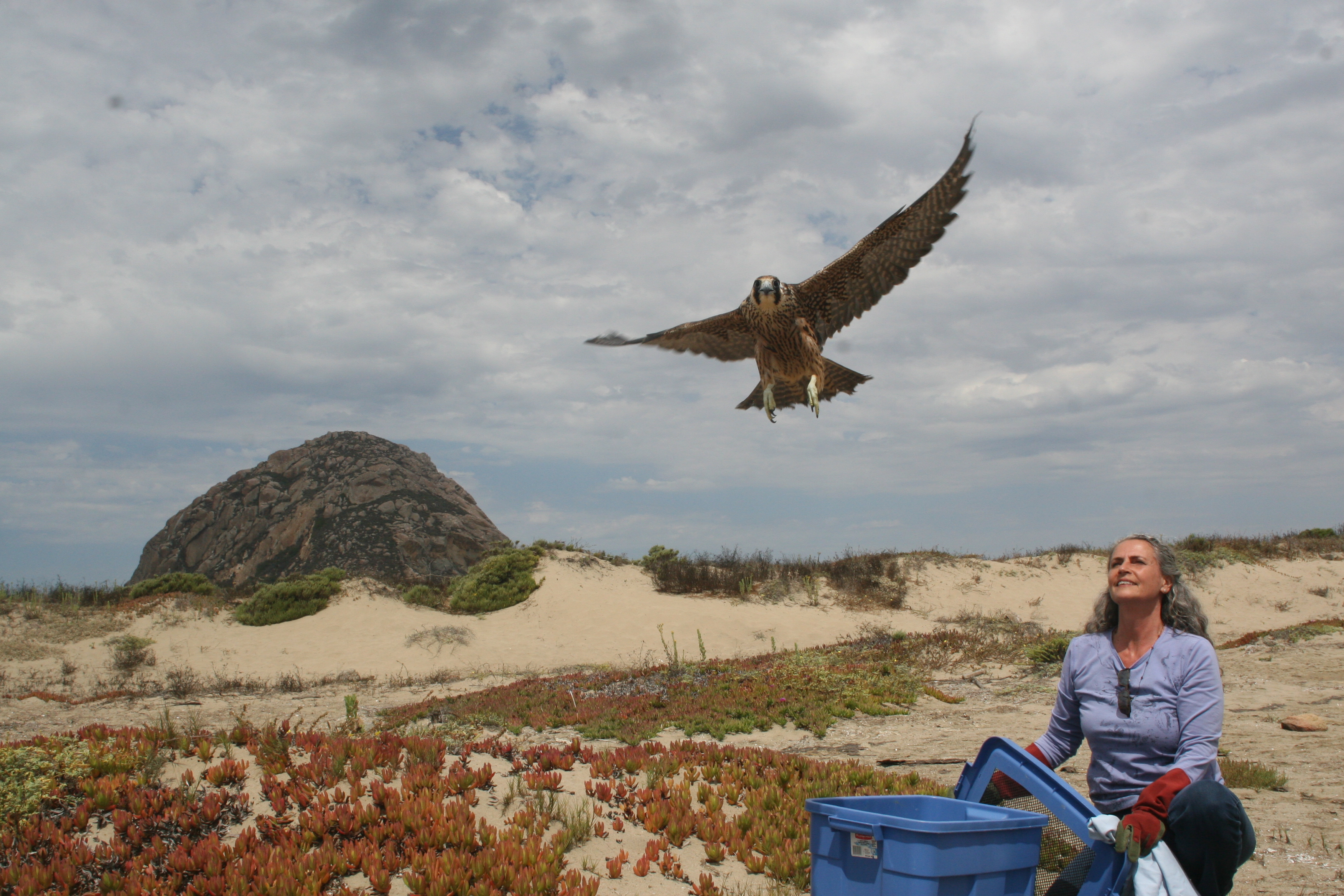
Article and photo by Neil Farrell, Tolosa Press
A juvenile female peregrine falcon is flying once again over Morro Bay Harbor after being rescued, rehabbed and released by Pacific Wildlife Care.
On Saturday, Jeri Roberts of PWC, along with peregrine researchers and friends, hitched a ride with the harbor patrol to the Sandspit at Sandal’s Cove to release the bird back into the wild. There she will possibly rejoin three siblings, part of a brood that hatched and fledged off Morro Rock this season.
The birds were hatched around Easter and flew their nest high up on the southwest side of the Rock on May 22, said Bob Isenberg, of the group Pacific Coast Peregrine Watch (see: pacificcoastperegrinewatch.org) . This bird was found June 26 with a broken wing, wallowing in the water off the Sandspit. She was going to die, but someone gathered the bird up and set in motion its salvation.
PWC took the bird in at its triage center on the power plant property. Roberts said it was examined by a veterinarian, who diagnosed the wing break. “He prescribed the human equivalent of bed rest,” said Roberts.
So the bird was confined in a crate to allow the wing to heal itself. That presents a problem for a critter that can fly 200 mph and is the fastest animal on earth.
“They can ‘de-condition’ rapidly,” explained Roberts, so the plan was to get the bird moving around again as quickly as possible.
“Peregrines are high strung,” she said, “and the triage center has a lot of activity, a lot of noise.” So the bird was transferred to Roberts’ home in Prefumo Canyon. There she has graduated sizes of flight cages, from 6-foot, to 12’, then a 15’ X 10’ and eventually into a 30-foot flight cage.
Though she has another peregrine that along with a Merlin, are used for PWC’s educational programs, they don’t take to company very well.
“You can’t mix two peregrines together,” she said, “they will kill each other.” Playing nice also apparently doesn’t apply for the parent birds either, that’s why they had to release this one on the Sandspit instead of at Morro Rock. Its parents would likely drive her off and Roberts said they would probably have to rescue it again.
In the big flight cage, Roberts said the falcon shared time with an owl also being rehabbed. “They traded off,” she explained. “We had this whole diurnal and nocturnal thing going. I’d take the peregrine out in daylight and the owl would come out at night. We try to get the birds back out into the wild as soon as possible.”
It took about eight weeks to finally release the falcon, which isn’t cheap for an all-volunteer non-profit organization. The falcon ate two 5-week old quail a day, costing more than $5 a day.
“We did right by the bird,” said Roberts. “It’s an expensive undertaking, with x-rays, vet visits, the good diet and feather supplements. She was still growing feathers. It’s turned out very well.”
Once nearing extinction due primarily to habitat loss and poisoning with DDT. The peregrine falcons have made a remarkable comeback since the population hit rock bottom in the 1980s.
Now the four young falcons will have to carve out a niche for themselves but not necessarily here. Falcons are known for traveling far from home to settle down.
For instance, birds that have been tagged locally have shown up in the Channel Islands, Los Angeles and even San Diego.
Isenberg said peregrines have been documented nesting up and down the Central Coast spaced out about every 8-10 miles. Locally there are pairs in Montaña de Oro, Morro Rock, Hollister Peak, Avila Beach, Pismo and on down.
According to Wikipedia, peregrine falcons are the second most widely spread species of bird in the world. About the only place they are not found is Antarctica and above the Arctic Circle.
The birds have adapted to urban living too, nesting on tall buildings and even cathedrals in many large cities. Oddly enough, in the cities, a falcon’s main prey is pigeon, which Wikipedia said is the most widely spread species. On the Sandspit, the falcons have apparently been snacking on snowy plovers.
Share this:
Posted in falcon, juvenile, Morro Rock
Tagged accident or injury, falcon, juvenile, Morro Rock, peregrines, survival
Leave a comment
The matriarch of Morro Rock…
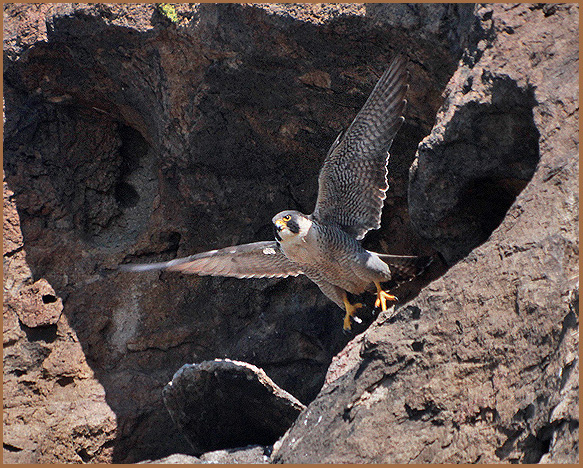
This is the fifth in a series of tales about the “famous and not-so-famous birds of Morro Rock.”
This bird that I am speaking of is probably the most famous bird in the las two decades as far as I’m concerned. She is the matriarch of Morro Rock. She was a young female when she arrived at Morro Rock in the late summer of 2000, a sub-adult still carrying some juvenile plumage. That summer we had lost a banded female named “Millie.” No one knew what happened to “Millie.” There was no carcass; she was just gone. Her mate at the time was a banded tiercel named “Rudy” because of the “RU” on one of his banded legs. “Rudy” had been single for some time when the young female arrived. He tolerated her perching on his rock and as the weeks passed by he showed some interest by flying around her. Nothing spectacular.
As October turned to November and the days got shorter, she was now in adult plumage, distinct white patch on the side of her head to contrast the black mustache and yellow cere. She is a powerful and swift female, large, but not overly large. Somehow they know after the winter Solstice about Christmastime, there is something in the air that says courtship.
The male starts flying faster and closer to her as she perches to watch this display of speed, power and agility which is all meant for this young maiden. Within a couple of days he approacher her overhead, the young female went into a submissive squat, her chin on the rock and her tail high. They continued this several times a day for the next three months. That year, her maiden year, she had one chick in a nest site called the “mailslot.” Since that first year and the ten years after, she has given us 25 young falcons from three different males. She is about thirteen now and just as beautiful as the day she arrived that late summer day.
Happy trails, Bob
Share this:
Posted in chicks, falcon, juvenile, Morro Rock
Tagged breeding, chicks, courtship, falcon, juvenile, Morro Rock, peregrines
Leave a comment
High tailing it…
Posted in chicks, falcon, juvenile, Morro Rock
Tagged breeding, chicks, courtship, falcon, juvenile, Morro Rock, peregrines
Leave a comment
A fisherman of another kind…
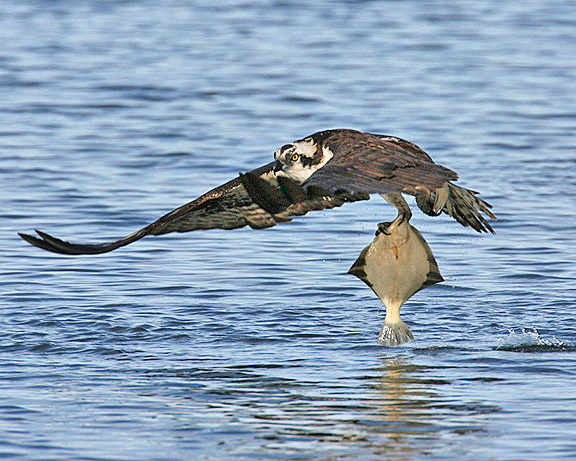
Photo by Cleve Nash
This is the fourth in a series of tales about the “famous and not-so-famous birds of Morro Rock.”
The bird I am speaking of is our resident osprey, a magnificent and colorful large bird of prey. He does not make his home on the rock but he visits there frequently. Most of the time, he is in and around the bay. Perching on sailboats, fishing vessels, lamp posts, etc. Morro Bay, you might say, is his home. In the five or six years I’ve watched him, he has never had a mate or nest site. I don’t know if he is male or female.
The nearest thing to a home was a tree at the west end of the Morro Bay Museum/marina parking lot. There you would find him in the tree and Cleve Nash on the ground with camera in hand. The water was very shallow there even at high tide. This explains why he was able to take the flounder and diving ducks such as the Bufflehead, in the photo below, although he is able to catch prey at three meters in depth.
One day I asked Cleve if he ever got a shot of him entering the water with his talons stretched straight out in front. This he does at the very last second before hitting the water. Cleve responded at that time that he had taken over 900 photos and hadn’t gotten that one yet. When it comes to photography, Cleve is relentless and stubborn with his subjects. One time while shooting White-tailed Kites near San Simeon, Cleve stood for a long period of time with a camouflage drape over himself. A Cooper’s Hawk landed on the lens of his 500 mm camera eighteen inches from his face. This is dedication!
The osprey’s favorite tree fell down last year. Now he and a great egret fuss over a tree nearby. I tried to get some people interested in putting up a tall pole with a tire on top to attract a mate, but I’m not a politician and nothing came of it. He’s still here and roams the bay and if you walk the waterfront to look at the bay or sunset and see scales falling from the sky. It’s just the osprey on the lamp post above your head enjoying his evening repast.
Happy trails, Bob
P.S. The fish is a Starry Flounder.